


MAP Boost Sensor for Hyundai iLoad iMax Kia Sorento D4CB 39300-2G000
Workshop Grade Replaces 39300-2G000
BRAND NEW *OEM Quality* 2 bar turbo boost pressure sensor with integrated air temperature sensor to suit the Hyundai iLoad and iMax TQ 2.5L D4CB and Kia Sorento JC.
When this sensor drifts the ECU loses its boost reference and the van goes flat with a load in the back. This is a direct replacement that restores accurate boost monitoring, shipped via Australia Post Express from Victoria.
TO SUIT
Built for the D4CB 2.5L CRDi in the Hyundai H-1 iLoad and iMax TQ across the Euro 4 Euro 5 and Euro 6 variants in both 100kW and 125kW, and shared with the Kia Sorento JC 125kW. Full build date coverage is in the compatibility chart on this page.
FITMENT CHECK
This sensor mounts on the INTERCOOLER OUTLET PIPE, not on the inlet manifold. The D4CB also carries a separate 3-pin boost sensor under part number 39200-2F000 - this one is the 4-pin unit with two bolt holes. Check both the location and the pin count on your original before ordering.
OEM PART NUMBERS
- 39300-2G000
- 39300-84400
- 9022040007
OTHER PART NUMBERS
- VEMO: V52-72-0136
- NTK-AU: EPBMPT4-V014Z
- HELLA: 6PP 358 152-211
- DELPHI: PS10152
- ERA: 551110
- WALKER PRODUCTS: 225-1274
PACKAGE INCLUDES
1 x 2 bar turbo boost pressure sensor with integrated air temperature sensor, 4-pin oval connector and two mounting bolt holes.
ABOUT THIS SENSOR
Mounted after the intercooler, this sensor reports charge air pressure and temperature so the ECU can work out the true density of the air reaching the cylinders and set injection and boost accordingly. The 2 bar range lets it read positive boost above atmospheric pressure.
On a TQ van this sensor lives on the pipework in a hot engine bay and is heat cycled every shift. Because these vans are almost always loaded, a drifting reading gets blamed on the payload rather than the sensor - the van still drives, it just will not pull like it used to, and the fuel spend creeps up quietly across the year.
COMMON SYMPTOMS OF FAILURE
- Check engine light with P0105 P0106 P0107 or P0108 stored
- Flat throttle response once the turbo should be on boost
- Noticeably worse fuel economy across the fleet
- Intermittent limp mode that clears on restart
- Loss of pulling power with a loaded van
- [02/12 - 10/21] HYUNDAI H-1 / iLOAD TQ CRDi (2.5L 4cyl D4CB Euro 4/Euro 5/Euro 6 100kW)
- [02/08 - 10/21] HYUNDAI H-1 / iLOAD TQ CRDi (2.5L 4cyl D4CB Euro 4/Euro 5/Euro 6 125kW)
- [02/12 - 10/21] HYUNDAI H-1 / iMAX TQ CRDI (2.5L 4cyl D4CB Euro 4/Euro 5/Euro 6 100kW)
- [05/08 - 10/21] HYUNDAI H-1 / iMAX TQ CRDi (2.5L 4cyl D4CB Euro 4/Euro 5/Euro 6 125kW)
- [08/07 - 09/09] KIA SORENTO JC I CRDi (2.5L 4cyl D4CB Euro 4 125kW)
What fault codes does a faulty MAP sensor trigger?
A faulty MAP sensor typically triggers codes P0105 to P0109. P0105 indicates a circuit malfunction, P0106 indicates the signal is out of range, P0107 and P0108 indicate the signal is too low or too high respectively, and P0109 indicates an intermittent circuit fault. These codes combined with symptoms such as poor idle and black smoke are strong indicators of MAP sensor failure.
How do I test a MAP sensor?
With an OBD2 scanner in live data mode, the MAP sensor should read close to atmospheric pressure (around 101 kPa) with the engine off, and drop to 30 to 50 kPa at idle with the engine running due to manifold vacuum. Under wide open throttle the reading should rise back toward atmospheric. A sensor that reads flat or does not respond to throttle changes has failed. You can also test supply voltage and signal output with a multimeter.
Can I drive with a faulty MAP sensor?
You can drive short distances but engine performance will be noticeably degraded. The ECU uses the MAP sensor to calculate fuel delivery - a faulty sensor causes incorrect fuelling which leads to poor economy, rough running, and increased emissions. On turbocharged engines a faulty MAP sensor can also prevent boost control from operating correctly. Replace it as soon as possible to avoid further damage.
What does a MAP sensor do?
The Manifold Absolute Pressure (MAP) sensor measures intake manifold pressure to help the ECU calculate the correct fuel and ignition timing. It is critical for engine efficiency, particularly on turbocharged and supercharged vehicles.
What are the symptoms of a faulty MAP sensor?
Symptoms include poor acceleration, rough idle, excessive fuel consumption, black smoke, engine hesitation, and a Check Engine light with codes P0105-P0109. Turbocharged vehicles may also experience boost control issues.
What is the difference between a MAP sensor and a MAF sensor?
A MAF (Mass Air Flow) sensor directly measures the mass of air entering the engine. A MAP sensor measures manifold pressure and the ECU calculates air mass from that reading. Many vehicles use one or the other; some use both. They are not interchangeable.
| Identification | |
|---|---|
| SKU | 393002G000-CMS302-ILOAD |
| Brand | OEM |
| Part Numbers | |
| Part Number | CMS302 |
| Reference OEM Number | 39300-2G000 |
| Other OEM Numbers | 39300-2G000, 39300-84400, 393002G000, 9022040007 |
| Related Part Numbers | CMS302, MP156GEN, MP156, TMP042, DMAP1007 |
| Trade Part Numbers | VEMO: V52-72-0136, NTK-AU: EPBMPT4-V014Z, HELLA: 6PP 358 152-211 |
| Product Specifics | |
| Product Type | SENSOR |
| Sensor Type | Boost Pressure Sensor |
| Fitting Position | Intercooler outlet pipe |
| Number of pins | 4-Pin |
| Connector Shape | oval |
| Supplementary Article Info | with integrated air temperature sensor |
| Pressure Range | 2 bar (up to 200 kPa) |
| Number of mounting bores | 2 |
| Compatible Makes | Hyundai Kia |
| Fitment Type | Direct Replacement |
| Other Details | |
| Note | 2 bar boost sensor - 2 bolt holes - not the 1 bar type |
| Unit Of Measure | ea |
Be The First To Review This Product!
Help other SENSORGAL LTD. users shop smarter by writing reviews for products you have purchased.
More From This Category
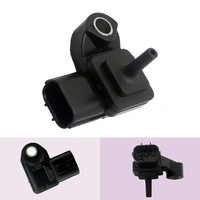
MAP Sensor for Mitsubishi Triton Ml Mn 2.5L 4D56 Diesel Engines 1865A035
SKU: MP161-1865A035_1
$237.00 RRP $436.35
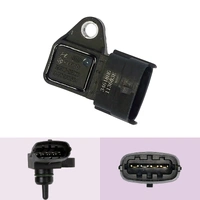
MAP Sensor 39300-2B100 for Hyundai i30 Elantra Kia Cerato Rio G4FA G4FD
SKU: 393002B100-i30
$119.97 RRP $167.99
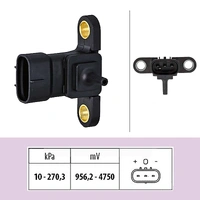
Boost Pressure Sensor for Toyota Hiace 2KDFTV 2.5L KDH REGIUS COMMUTER Diesel
SKU: MP189-CMS314-1
$139.97 RRP $238.95
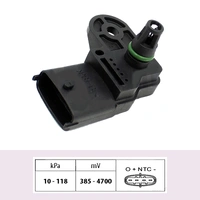
$119.97 RRP $139.97
$119.97 RRP $146.95
$87.97 RRP $139.97
$89.97 RRP $189.45

$89.97 RRP $149.97